
The 60 second video version, if you'd rather watch first:
AI agents need credentials to do anything useful. They call APIs, query databases, connect to services. So developers give them credentials, Anthropic API keys, AWS access keys, database connection strings, and get back to building. It works. The agents are productive. Everyone is happy.
What just happened, quietly, is that the credential surface area grew. Not by one. By however many endpoints, servers, pipelines, and developer machines now hold copies of that secret. And it will keep growing, because that's what AI adoption looks like. Every new agent, every new workflow, every new developer who wants to build with Claude Code is another checkout from the vault. Another copy somewhere.
At a certain point, and most orgs are already past it, you are not managing credentials anymore. You are managing sprawl. Sprawl cannot be secured by watching it harder.
This is not a temporary problem. It is a structural one, and it gets worse in direct proportion to how successfully your organization adopts AI. The teams winning on AI adoption today are quietly building the credential risk problem they'll be dealing with for the next decade. Nobody has handed them the infrastructure to avoid it. Beyond Identity is building that infrastructure. That's what this post is about.
The vault is not the problem. The checkout is.

Most teams have done the right things. They're using a secrets manager. They have rotation policies, more or less. Audit logs exist.
But those tools were designed for a world where a finite number of human-operated systems needed credentials, credentials were checked out occasionally, and when something went wrong, the blast radius was bounded.
AI agents break every one of those assumptions.
When a developer pulls an Anthropic API key and hands it to an agent, that key is now on their machine. When the agent runs in a CI/CD pipeline, the key is in the pipeline. When the workflow gets copied to another environment, the key comes along. The vault is doing its job. The checkout process is the problem. Every checkout is a copy, and every copy expands your surface area.
The traditional response is monitoring. Watch the endpoints. Alert on anomalies. Spin up more tooling, hire people to watch the tooling. This is credential security as symptom management: you never actually reduce the surface, you just try to watch it closely enough that you catch the breach before it gets bad. That approach made a certain kind of sense when the number of workloads was manageable. When AI agents multiply that number by ten, by a hundred, the math breaks. You cannot watch your way out of exponential sprawl.
There is only one real solution: stop copying secrets to endpoints in the first place.
From credential sprawl to one hardened chokepoint

What if the API key never left the cloud?
With Ceros by Beyond Identity, the Anthropic API key gets stored once, in the Beyond Identity Cloud. That's the only place it ever lives. It doesn't get distributed to servers. It doesn't land on developer machines or travel through pipelines or get pasted anywhere.
When an AI agent needs to make an API call, the traffic routes through the Beyond Identity proxy. Alongside that request, the agent sends a DPoP signature, a cryptographic proof anchored in hardware on the device, that attests which machine is making the request. Beyond Identity validates the signature, evaluates your policy, injects the secret, and completes the call. The credential never touches the workload.
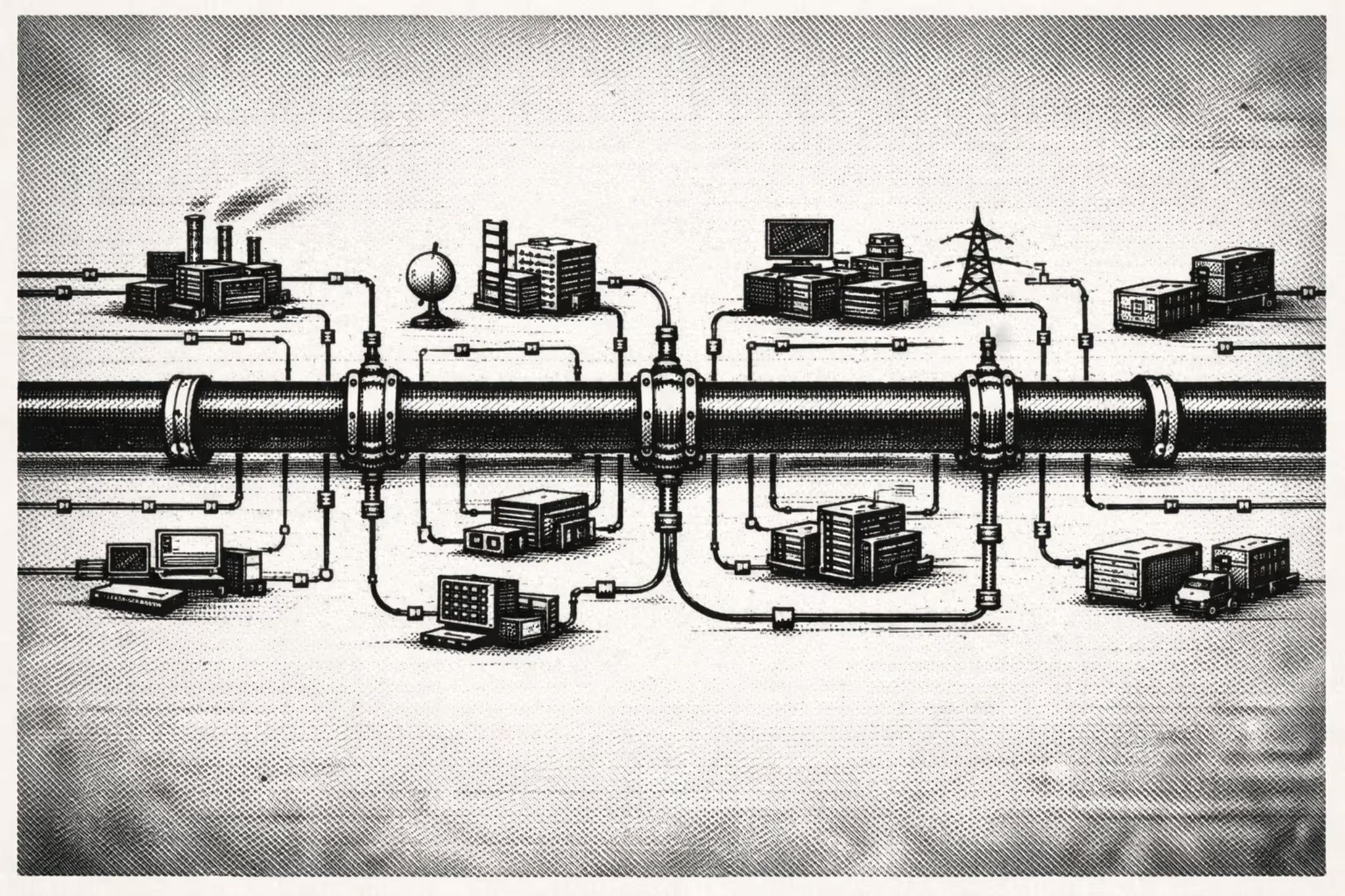
The result is a fundamental shift in what the attack surface looks like. Instead of a distributed credential living on every endpoint that needs it, you have one piece of hardened infrastructure. Your watch-and-protect perimeter shrinks from sprawling to surgical, and the monitoring you do need becomes tractable again because there's actually something bounded to monitor.
This is what we mean by set it and forget it. Not because security gets easier to ignore, but because the architecture handles it correctly by design.
What happens when a workload gets compromised
In traditional environments, this is the scenario that ends conversations. An attacker is inside a machine. The credential is on the machine. Game over.
Here's what that scenario looks like with Ceros by Beyond Identity.
The attacker has the device. The device has no secret. Every request the compromised workload makes still routes through the Beyond Identity proxy, where the policy engine evaluates device posture, MDM risk score, and real-time signals from the machine. The moment the proxy detects something is wrong, it blocks the request. The API key never moved. The rest of your workloads never know anything happened.
Copying credentials off a Beyond Identity-enrolled device doesn't work because there's nothing to copy. The credential isn't there. What's there is a hardware-bound attestation anchored in the device's secure enclave, not extractable, not replayable, not transferable. An attacker with full access to the machine has a device that can make authenticated requests only while posture holds. The moment it doesn't, they have nothing.
This is the difference between security theater and security architecture.
This is how Ceros works with Claude Code
This isn't a concept. It's how Ceros operates today.
Most AI security tools sit at the network layer. They intercept traffic after it leaves the machine, infer context from what they can see, and make access decisions based on an incomplete picture. By the time they see the request, the full story of how it got there, which human launched the session, which process chain spawned the agent, whether the device is actually healthy, is already gone.
Ceros works differently. The Ceros agent lives on the device, right next to Claude Code, at the data plane where the action actually happens. Before a single token is generated, it captures the full picture: the complete process ancestry from login shell to agent invocation, the OS and kernel state, whether disk encryption is enabled, whether endpoint protection is running, whether Secure Boot is on. Every binary in the process chain is hashed. If anything has been swapped out or tampered with, it knows. All of that context is collected in under 250 milliseconds, signed with a hardware-bound cryptographic key, and travels with every request the agent makes for the entire session.
This is not a one-time check. Posture is evaluated continuously for as long as the session is alive. If the security state of the machine changes while the agent is active, Ceros sees it and acts on it immediately.
That on-device enforcement layer is what makes the credential architecture possible. Your Anthropic API key gets stored once in the Beyond Identity Cloud and never leaves. When the agent calls the Anthropic API, the traffic routes through the Beyond Identity proxy, which validates the DPoP signature from the device, runs the posture check, applies your policy, and injects the secret. The API key never touched the developer's machine. The audit trail is tamper-proof. Policy is enforced at runtime, at the source, not observed from the edge and hoped for.
From the developer's perspective: they installed Ceros, they launched Claude Code, everything works. From a security architecture perspective: the credential surface area for that entire workflow is one piece of hardened infrastructure, enforced at the data plane, with complete context, before anything leaves the machine.
And key rotation? One change in the Beyond Identity Cloud, propagated instantly, zero downtime, no developer involvement, no redeployment. The key was only ever in one place.
Why the window is now
Every week without principled credential infrastructure is another week of compounding surface area. Teams are making architectural decisions right now, under pressure, without good options. Most are building proxy layers and monitoring stacks that solve for today's agent count. That code is going to be hard to unwind.
Every AI agent running in production is a workload that needs a credential. That number is about to dwarf every other class of workload in existence. The category is not a question. The only question is who builds the infrastructure layer everyone else depends on.
Beyond Identity is building it now, while the architectural decisions are still being made and before the wrong patterns calcify across the industry.
What we're building, and why the foundation matters
We are not building an MCP gateway. We are not building another monitoring tool that watches AI traffic and sends alerts. We are not building a policy engine that lives at the network edge and sees things only after they've already happened.
We built Ceros from the same architectural thinking that eliminated phishable credentials for enterprises: hardware-bound identity, zero trust, cryptographic proof, applied to the machine where AI agents actually live.
Beyond Identity has done this before. We saw the human identity problem before the market did, built the principled answer while everyone else was patching phishable credentials, and became the infrastructure layer enterprises trusted with their most sensitive access decisions. Non-human identity in the agentic era is the same pattern: a structural problem about to become impossible to ignore, a market full of tactical responses that don't address the root cause, and one architectural answer that actually holds. We've built the category-defining solution once. We're doing it again.
If the agent's identity isn't hardware-bound, everything downstream is guesswork. The foundation has to be right. Every enterprise adopting AI agents is going to need this infrastructure, not as a nice-to-have but as a prerequisite for operating at scale. The question was never whether the category exists. It's who builds the foundation everyone else stands on.
Follow me on X: x.com/coltonchojnacki
Ceros is built by Beyond Identity. SOC 2 Type 2 compliant. FedRAMP Moderate ready. Deployable as cloud SaaS, self-hosted, or fully air-gapped on-premises.